SITUATION
It annoyed me. Every conversation about AI in marketing ended the same way - someone predicting that AI would eventually take over marketing entirely. It cannot. AI cannot replicate the Insight Gap: the cultural touch points, the emotional cues, the strategic judgment that tells you why a campaign lands in one market and dies in another. That is a human job and will always be one.
The second problem was structural. From the top down, AI was being touted as a revolution. However, from the bottom up, people were bolting AI tools onto the same systems they'd always had, and calling it transformation. 78% of organizations have adopted AI in marketing. A gen AI tool writes great ad copy that the personalization engine never sees. A predictive model flags high-propensity customers that the campaign team isn't briefed on. Attribution is comprehensive, but the next campaign starts from scratch. The tools work, but they are not speaking to each other.
Marketing strategy wasn't the issue. The operating model underneath it was. Prof. Mohanbir Sawhney and I identified this as a defining problem of modern marketing.
It annoyed me. Every conversation about AI in marketing ended the same way - someone predicting that AI would eventually take over marketing entirely. It cannot. AI cannot replicate the Insight Gap: the cultural touch points, the emotional cues, the strategic judgment that tells you why a campaign lands in one market and dies in another. That is a human job and will always be one.
The second problem was structural. From the top down, AI was being touted as a revolution. However, from the bottom up, people were bolting AI tools onto the same systems they'd always had, and calling it transformation. 78% of organizations have adopted AI in marketing. A gen AI tool writes great ad copy that the personalization engine never sees. A predictive model flags high-propensity customers that the campaign team isn't briefed on. Attribution is comprehensive, but the next campaign starts from scratch. The tools work, but they are not speaking to each other.
Marketing strategy wasn't the issue. The operating model underneath it was. Prof. Mohanbir Sawhney and I identified this as a defining problem of modern marketing.
TASK
As the lead curriculum designer, design an AI-Native Marketing (MKTG 468) course from scratch at the Kellogg School of Management. Co-architect a framework that would reframe marketing as a connected, AI-native operating system. Every case study, module, dataset, and lab had to be built from scratch in 2026.
As the lead curriculum designer, design an AI-Native Marketing (MKTG 468) course from scratch at the Kellogg School of Management. Co-architect a framework that would reframe marketing as a connected, AI-native operating system. Every case study, module, dataset, and lab had to be built from scratch in 2026.
ACTION
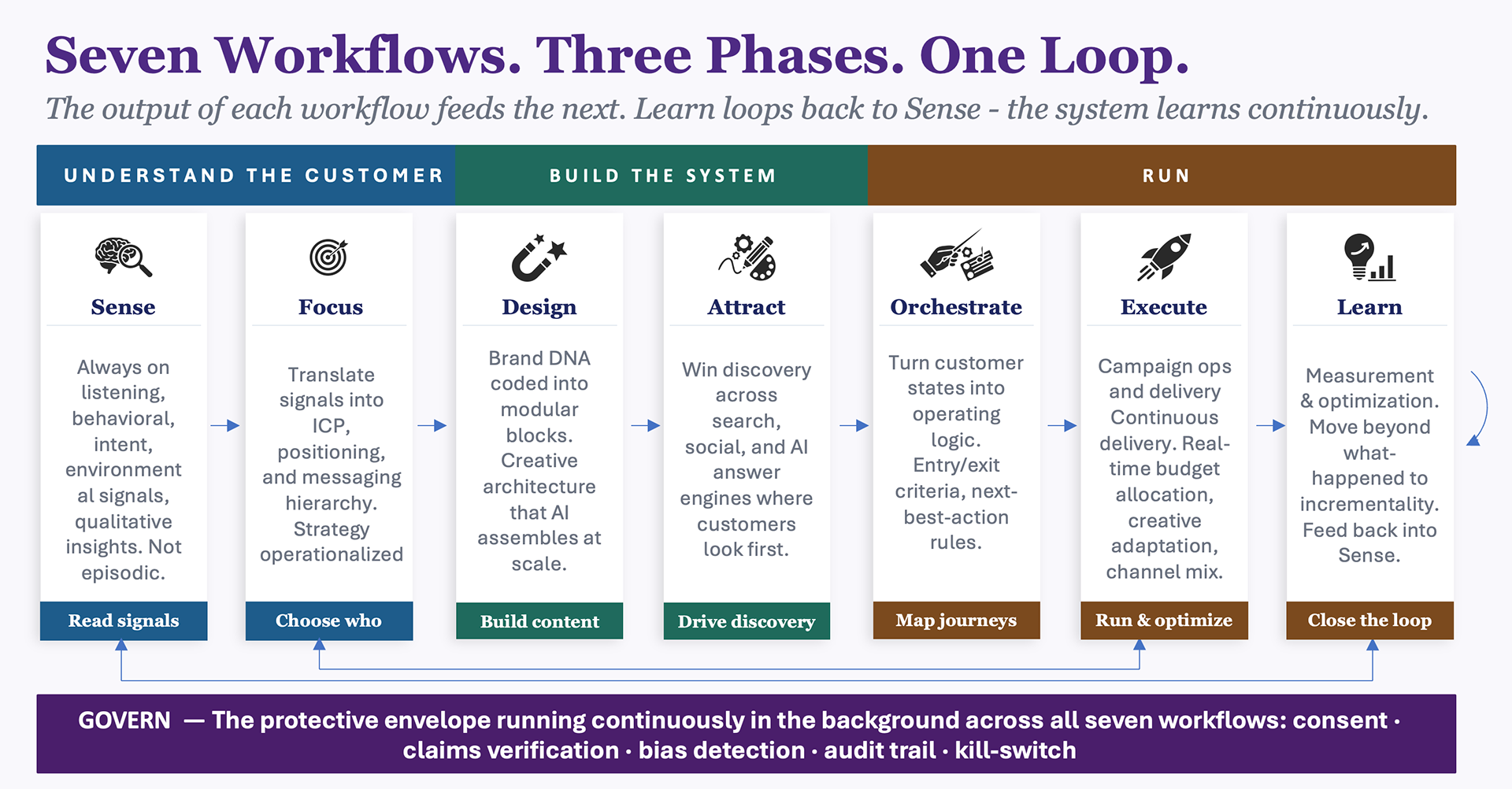
Co-developed the Intelligent Marketing Operating System (I-MOS) framework with Prof. Sawhney. The framework treats marketing as seven continuous workflows running as a loop: Sense, Focus, Design, Attract, Orchestrate, Execute, Learn, with Govern as the continuous protective envelope across all seven, handling consent, claims verification, bias detection, and kill-switch protocols. Every workflow's output is the next workflow's input. Learning compounds in Shared Memory without anyone rebuilding from scratch.
Co-developed the Intelligent Marketing Operating System (I-MOS) framework with Prof. Sawhney. The framework treats marketing as seven continuous workflows running as a loop: Sense, Focus, Design, Attract, Orchestrate, Execute, Learn, with Govern as the continuous protective envelope across all seven, handling consent, claims verification, bias detection, and kill-switch protocols. Every workflow's output is the next workflow's input. Learning compounds in Shared Memory without anyone rebuilding from scratch.
Most importantly, the Insight Gap and JTBD (Jobs to be done) sit at the heart of the course: strategic judgment, cultural relevance, brand nuance, and resonance are things only humans can bring. And everything should start with a consumer-centric mentality. I-MOS is designed so that efficiency never replaces that human touch. Every course, every case study, every dataset, and assignment is designed with a business-first lens and grounded in real problems.
Built the entire curriculum from scratch: every lecture script, case study, assignment, and rubric. And for two audiences: Kellogg MBA students and CMOs and Senior executives at Emeritus.
Built the entire curriculum from scratch: every lecture script, case study, assignment, and rubric. And for two audiences: Kellogg MBA students and CMOs and Senior executives at Emeritus.
RESULT
AI Native Marketing (MKTG 468) taught at the Kellogg School of Management, Spring 2026. Listed in the official Kellogg course catalog and the Emeritus executive program, live globally, targeting CMOs and senior marketing leaders across 80+ countries. Greenfield curriculum, slated to be published at KTR (Kellogg Teaching Resource).
AI Native Marketing (MKTG 468) taught at the Kellogg School of Management, Spring 2026. Listed in the official Kellogg course catalog and the Emeritus executive program, live globally, targeting CMOs and senior marketing leaders across 80+ countries. Greenfield curriculum, slated to be published at KTR (Kellogg Teaching Resource).

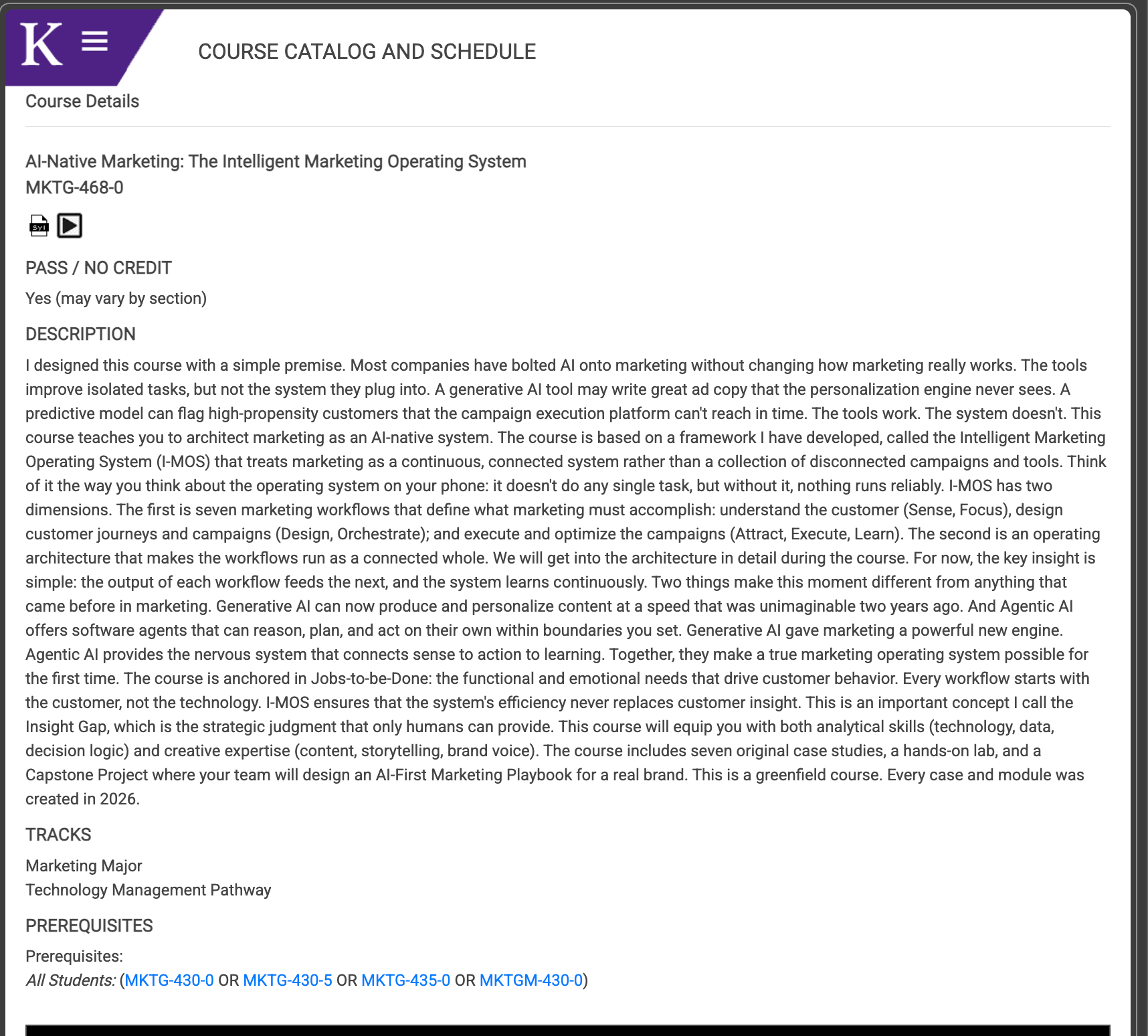
Three signature pieces stand out:
The Salesforce Agentforce Capstone was built around one of the most complex real GTM problems in enterprise SaaS right now. Salesforce is taking Agentforce to market while simultaneously shifting from per-seat subscription to consumption-based pricing.
I designed it differently; I brought in internal enablement complexity. I created six teams, each with a distinct strategic mandate and business goal. - New Logo Acquisition, Installed Base Expansion, Renewal Defense, Champion-led Growth, Competitive Displacement, and Internal Marketing for the pricing transition. All six teams work on the same custom synthetic dataset: 100 accounts, 374 buying committee contacts, and 2,912 behavioral signals over 24 months, product enablement data, and 200 internal enablement data. The data had several false positives and was deliberately designed to produce wrong conclusions on surface-level analysis or blind AI use. It requires triangulation across different signal families and, more importantly, forces the human to lead the machine and practice the insight gap.
I designed it differently; I brought in internal enablement complexity. I created six teams, each with a distinct strategic mandate and business goal. - New Logo Acquisition, Installed Base Expansion, Renewal Defense, Champion-led Growth, Competitive Displacement, and Internal Marketing for the pricing transition. All six teams work on the same custom synthetic dataset: 100 accounts, 374 buying committee contacts, and 2,912 behavioral signals over 24 months, product enablement data, and 200 internal enablement data. The data had several false positives and was deliberately designed to produce wrong conclusions on surface-level analysis or blind AI use. It requires triangulation across different signal families and, more importantly, forces the human to lead the machine and practice the insight gap.
The GM Adobe Case maps GM's EV marketing deployment to solve for non-linear customer reentry. GM built an excellent system for customers who behave the way marketers wish they would. I rebuilt the journey for how EV purchases actually happen: 12-24 month cycles, non-linear reentry, household decisions, dormancy taxonomy, and reactivation logic for high-involvement categories.
The Agentic AI Lab was a hands-on pressure test where students spec and design a multi-agent workflow, defining each agent's persona, trigger, autonomy level, escalation rules, and kill-switch conditions for two distinct business scenarios - E-commerce lifestage basket optimization and product review summarization. The deliverable mirrors what a real marketing ops team would produce.